
[Written January 22, 2017]

I’ve been here in England for a little over a week, and what a week it’s been! I’m in England to study History, and since being here I have complete confidence that there’s very little elsewhere I could go in the world to academically and practically experience history. Hatfield (the small town the University of Hertfordshire is located) holds so much history itself. Hatfield House was where Queen Elizabeth I grew up, and St. Albans (a small charming town) outside Hatfield also holds immense English heritage.
St. Albans Cathedral is at the heart of St. Albans. Its original construction was started towards the end of the 11th century and rebuilt time and time again over the centuries. There’s amazing Norman architecture, influenced by the culture that William the Conqueror took with him upon his victory at the Battle of Hastings in 1066. Funny enough, the initial construction of the Cathedral was not by stone, but by brick from aging Roman walls in the area. The builders took the brick from the Roman walls, shaped it to look like stone and then painted it (poorly, by the way) to trick the eye into thinking it was marble. The Cathedral was disregarded during the Reformation. It was during this time that it’s reconstruction began, but with England establishing its own religion, The Church of England (Anglicanism), and separating itself was the Church in Rome, the Cathedral’s reconstruction was abandoned. As it was a Catholic Cathedral, it fell into disfavour with the people and their new faith. St. Albans was left in a partial heap of rubble for centuries afterward from debt, natural disasters and disinterest. It wasn’t until the 19th century, as a newly-dubbed Protestant church, did the Cathedral become what you behold today.

Saint Albans Cathedral is obviously named after the Saint himself. Saint Alban is one of the four recorded early Christian martyrs in Roman Britain. He is traditionally believed to have been beheaded in Verulamium (modern St. Albans) sometime during the 3rd of 4th century. His shrine is in the Cathedral and it’s very impressive. As for Saint Alban himself, the Cathedral has been rebuilt and devastated so many times over the past millennia, there is no obvious knowing where his remains are located.
After studying early medieval history last semester at Vancouver Island University, I understand more than ever the merciless persecutions Jesus followers endured. These early Christian saints perished in order to testify as powerfully as they could to the truth; both to their adversaries and to their flock by becoming death themselves as Christ did. To me, as a History student and follower of Jesus, these early Christian martyrs deserve the utmost respect for their valiance. It’s the same valiance that we still spiritually possess today as followers of Christ if we have the boldness to walk in it.
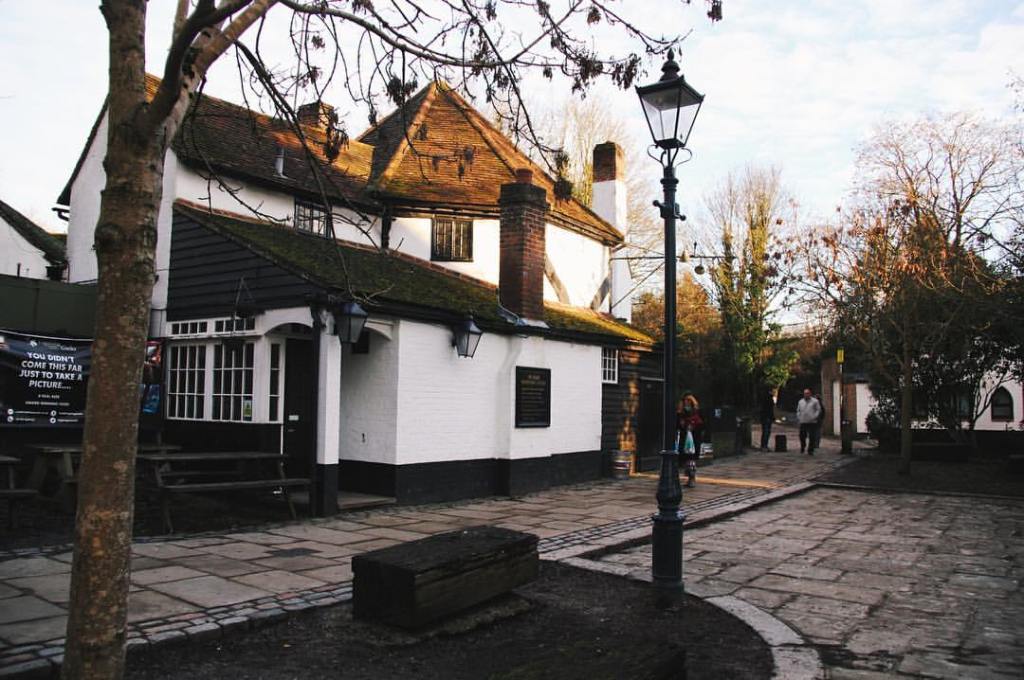
It’s a huge blessing to have friends here to take me to incredible places, like, allegedly, the oldest pub in Britain: Ye Olde Fighting Cocks, established in 793 AD. Who established pubs during the early viking invasions? The British of course.
Although the transition from Canadian life to British life has come with some big challenges, I am so happy to be here. God is revealing beauty to me with every new day. I decided to move out of residential dorms and into off-campus housing yesterday morning, and my heart could not be more content. Today, I’m drinking Tetley tea, eating homemade soup, and watching the Hobbit with my housemate– this is home!
Life is hard sometimes, but God is always good–even when I’m miserable; even when my leg is swollen and bleeding from falling; even when I’m totally lost because the bus driver missed my stop; even when I’m surviving on only cereal and yogurt for the first 6 days of my being. Writing this post in this current moment reminds me of God’s joyous delight for my life. Despite all the challenges, I’m so crazy thankful to be here.
Cheers my friends!
xx Beth




Oxford, Oxfordshire
 bethanyhenderson.com
Leave a comment